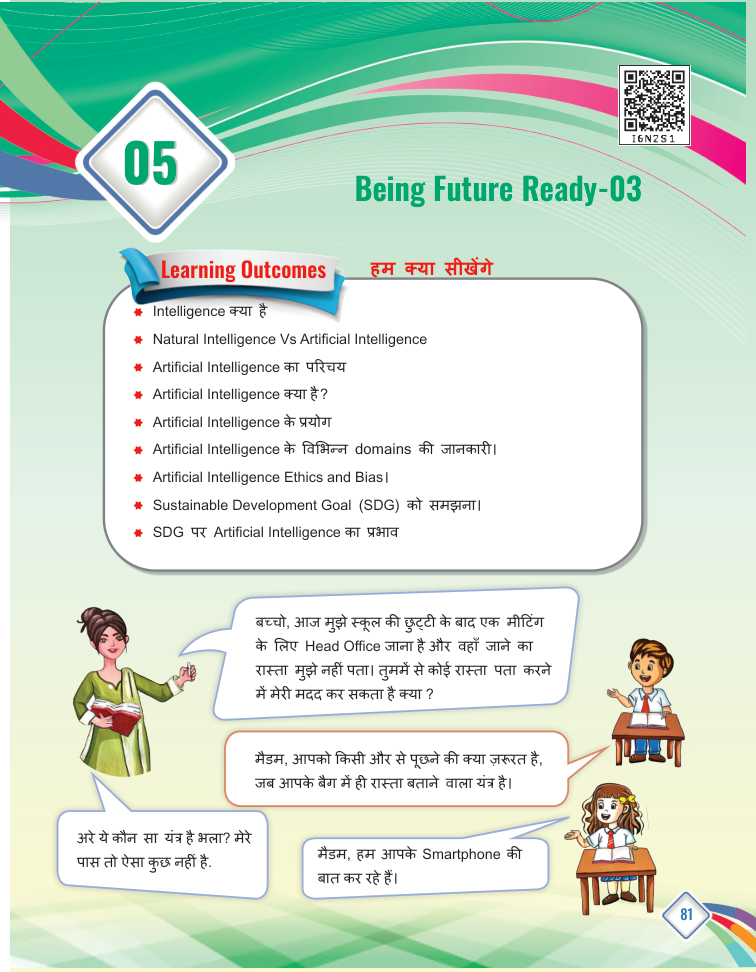
Being Future Ready-03 (Artificial Intelligence) - page from the textbook
Back to Class
5

Being Future Ready-03 (Artificial Intelligence)

81-115 • Source: SCERT Delhi ICT Textbook, Revised Edition 2026 4 Fun Facts
8 min read

The field guide

Understand it. Try it. Remember it.

Artificial intelligence describes computer systems designed to perform tasks that involve patterns, predictions or language. Explore how training data shapes a model, where AI tools can help and why people must still check fairness, accuracy and impact.

Textbook reference: pages 81-115

01
Examples
Patterns
03
Human check
Concept mapFollow the pathBeing Future Ready-03 (Artificial Intelligence): Examples, Patterns, Human check

In this lesson

01

Natural vs Artificial Intelligence

  1. 1

    Natural Intelligence: The intelligence nature gives to living beings - a child learns speaking by observing activities around them.

  2. 2

    Artificial Intelligence (AI): The intelligence built into apps and devices - an artificial way of giving machines the ability to think and learn like humans.

02

How Machines Learn

Definition

Definition: Like humans learn from experience, AI learns from data. Machines are trained with data and patterns, similar to how small children are taught.

Example: Google Maps

  • Learns constantly from real-time location data of lakhs of phones.
  • Uses old traffic information and road conditions.
  • Predicts which route has less traffic and shows the fastest path.
03

Domains of AI

  1. 1

    1. Data Science: The science of analysing data to extract information - e.g. analysing India's Olympic medals to understand performance.

  2. 2

    2. Computer Vision: AI domain where computers see and understand images - face filters, tracking, Amazon Go store checkout.

  3. 3

    3. Natural Language Processing (NLP): Helps computers understand human language - Siri, Alexa, Cortana, voice search, converting handwriting to editable text.

04

AI Ethics, Bias and SDGs

  • AI should be used ethically and fairly.
  • If the training data is unfair, AI can show bias - its decisions must be checked.
  • SDGs (Sustainable Development Goals) are global goals for a better world.
  • Used responsibly, AI can positively affect health, education and environment goals.

Your turn

Try a quick challenge

Imagine an AI tool sorting library books. Name one useful pattern, one type of example it needs and one mistake a person should check for.

Quick Revision

  • AI: giving machines the ability to think and learn like humans.
  • Natural Intelligence: nature-given intelligence of living beings.
  • Machine Learning: machines learning from data and patterns.
  • Data Science: extracting information by analysing data.
  • Computer Vision: computers understanding images.
  • NLP: computers understanding human language.
  • Bias: unfairness entering AI through unfair data.
  • SDG: Sustainable Development Goals.

Conclusion: AI learns from data like we learn from experience - used ethically, it can help build a better, more sustainable world.

Keep in mind

Quick recap

  • AI systems learn patterns from data; they do not share human understanding.
  • Different AI domains work with data, images or language.
  • Check outputs for errors, bias, privacy and real-world consequences.

Key Terms

Artificial Intelligence

मशीनों की कृत्रिम बुद्धिमत्ता

Natural Intelligence

प्रकृति प्रदत्त बुद्धिमत्ता

Data Science

डेटा विश्लेषण का विज्ञान

Computer Vision

कंप्यूटर की देखने-समझने की क्षमता

NLP

मानव भाषा समझने की तकनीक